


Haenyeo: the women who made the ocean a way of life
For generations, Jeju’s Haenyeo have freedived for a living. Their remarkable resilience combines training, cold exposure, culture and biological adaptation.
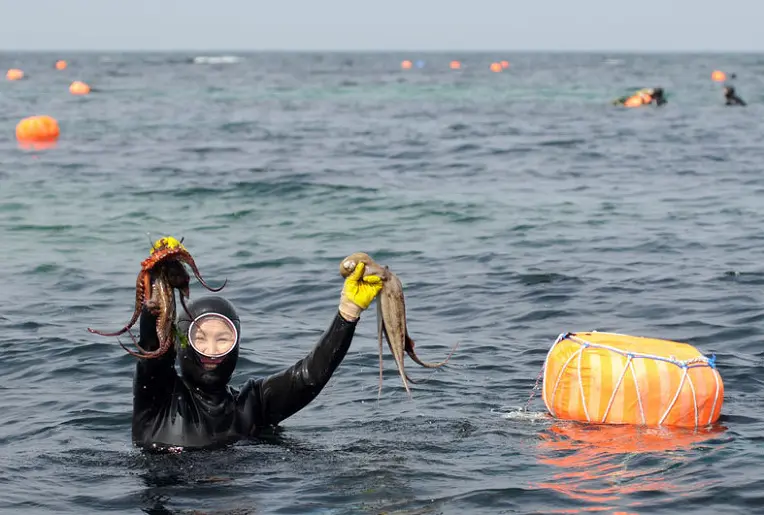
Before freediving was a sport, for them it was already work.
On the South Korean island of Jeju, generations of women entered the ocean to gather from the seabed the resources their families and communities depended on.
Abalone, sea urchins, and other marine resources were part of working days built around a sequence repeated over and over again:
descend, work, ascend, breathe, and dive again.
They are the haenyeo, Jeju’s “women of the sea.”
Their culture was inscribed by UNESCO on the Representative List of the Intangible Cultural Heritage of Humanity in 2016. But that recognition is about more than a subsistence activity.
It is also about knowledge.
Women learning from other women.
Techniques passed down within the community.
A way of understanding the sea that was not taught through words alone, but through accompanying others, observing, and repeating.
And perhaps that is where the truly extraordinary part of their story begins.
They Were Not Chasing Records
There is something that fundamentally separates the haenyeo from the modern image of freediving.
They were not trying to set a record.
They were working.
Their goal was not to stay underwater for as long as possible or reach a specific depth.
They needed to find resources on the seabed, manage their effort, return to the surface, recover, and dive again.
For hours.
For years.
In many cases, for much of their lives.
That makes their story particularly interesting to science.
Because when the same demands are repeated for decades, the body also responds to that history of exposure.
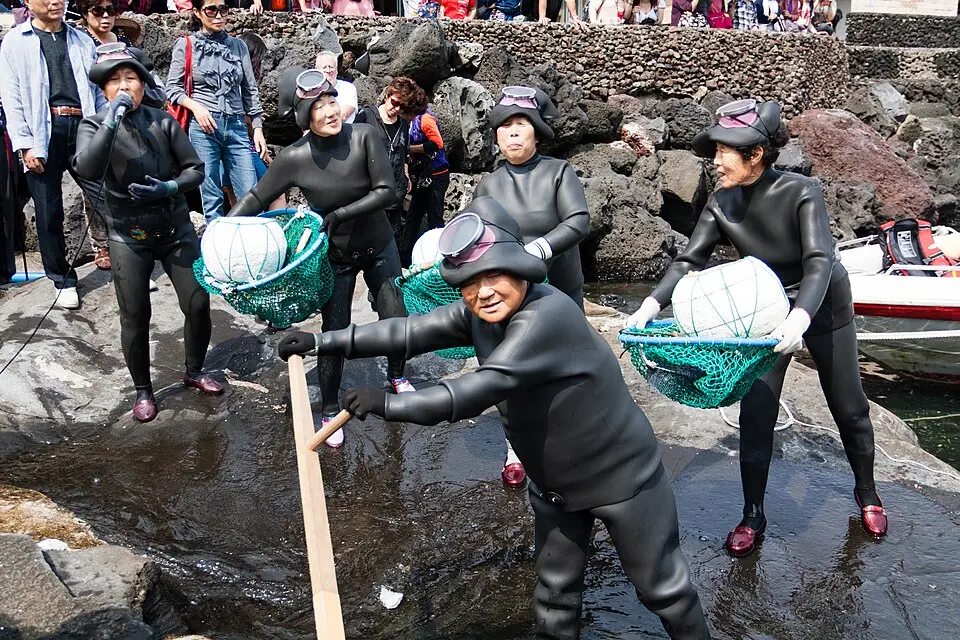 A group of Jeju haenyeo prepare by the sea with the floats and nets used during their harvesting sessions. · Photo: Idobi · Source: Wikimedia Commons · License: CC BY-SA 3.0

Learning to Live With the Cold
For much of the twentieth century, the haenyeo worked with very limited thermal protection.
Before modern wetsuits became widespread, exposure to cold water was an unavoidable part of every working day.
And this was not occasional exposure.
We are talking about hours in the sea, repeated over years.
Researchers began studying how their bodies responded to this environment and observed physiological characteristics related to cold acclimatization.
It might seem easy to conclude that these women simply possessed an exceptional and permanent resistance to cold.
But in the mid-1970s, one fundamental part of their environment changed.
Wetsuits began to become widespread among the haenyeo.
Suddenly, their bodies were no longer exposed to the same intensity of thermal stress.
And that change gave researchers something that is difficult to obtain under normal circumstances: a kind of natural experiment.
If certain responses were genuinely the result of continuous exposure to cold, what would happen when that exposure decreased?
A longitudinal study published in 1983 followed that process over several years.
Researchers observed that some of the physiological responses associated with that intense cold acclimatization gradually diminished after the adoption of wetsuits.
The implication was important.
At least some of what might have appeared to be a permanent characteristic had been acquired through years of exposure.
And it could change again when the conditions changed.
Decades later, other studies continued to investigate that relationship.
Some differences in responses to cold were still detectable in older haenyeo, although not every response was different and not every woman showed exactly the same pattern.
And that requires us to introduce an important idea.
Adaptation does not mean changing in one single, predictable way.
Not everyone responds in the same way.
And not every adaptation lasts forever.
Decades of Exposure Leave Their Mark
Cold was only part of the challenge.
Every descent also involved breath-holding.
When a person holds their breath and submerges, the body activates a series of physiological responses.
One of the best known is a reduction in heart rate, known as bradycardia, as part of the diving response.
For the haenyeo, what was remarkable was not necessarily a single extraordinary breath-hold.
It was the scale.
Field studies carried out in the 1980s documented working days made up of relatively short dives followed by repeated recovery periods at the surface.
During dives of around five metres, researchers recorded an average of approximately 32 seconds underwater and about 46 seconds of recovery at the surface.
At depths of around ten metres, the average dive time increased to roughly 43 seconds, while recovery could approach 85 seconds.
But the numbers tell only part of the story.
What was truly unusual was repeating this cycle throughout a working day and then continuing to do so for years.
Descend.
Search.
Gather.
Ascend.
Breathe.
And return to the seabed again.
When that sequence stops being exceptional and becomes routine for decades, an inevitable question arises.
How much of the body’s response comes from training, and how much might be related to the inherited biology of a population?
In 2025, a New Piece of the Puzzle Appeared
In 2025, an international team published one of the most interesting studies conducted on the haenyeo to date.
The researchers combined physiological testing with genetic analysis in an attempt to separate, at least partially, two forces that can act at the same time: training accumulated over a lifetime and the genetic history of the Jeju population.
During a simulated dive, they observed particularly pronounced bradycardia among the haenyeo divers.
The most striking explanation would have been to attribute it directly to genetics.
But the results did not point in that direction.
The haenyeo shared much of their genetic history with other Jeju residents who did not display the same cardiovascular response.
For that reason, the authors interpreted the pronounced bradycardia as a probable effect of training.
Decades of repeated diving appeared to provide a better explanation for that difference.
But the genetic analysis revealed another part of the story.
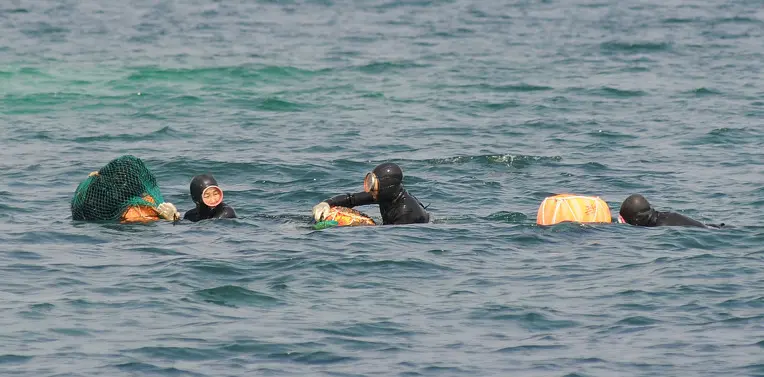 Several Jeju haenyeo work in the sea using their floats and nets during a harvesting session. · Photo: 김형찬 · Source: Wikimedia Commons · License: CC BY 2.0 KR

There Is No “Haenyeo Gene”
When analysing the genetics of the Jeju population, researchers identified variants showing signals compatible with natural selection.
Among them were variants associated with lower diastolic blood pressure and another variant previously linked to cold-water tolerance.
The authors themselves suggest that the latter could contribute to reducing susceptibility to hypothermia.
The important word is could.
Because finding a genetic variant associated with a trait does not mean discovering a “freediving gene.”
Nor does it mean that the haenyeo’s ability to work in the sea was predetermined by their DNA.
The conclusion is far more interesting.
Within a population that has lived for generations under very specific environmental and cultural conditions, different mechanisms can act at the same time.
One response may be primarily related to training.
Another may show signals compatible with genetic adaptation.
And both can form part of the same story.
Genetics and training do not have to compete as explanations.
They can overlap.
A Way of Life, Not an Experiment
It is easy to look at the haenyeo today from the outside and turn them into a fascinating case study in human physiology.
But they did not enter the water to prove a theory.
Nor were they trying to demonstrate how far the human body could go.
They entered because the ocean was part of their work, their economy, and their community.
For decades, their bodies were exposed again and again to the same challenges:
cold, breath-holding, pressure, physical effort, and recovery.
Science came later.
And it began trying to understand what that life had left in their physiology.
That order matters.
Because if we reduce the haenyeo to a genetic curiosity or a demonstration of physical endurance, we lose the most important part of their story.
Before they became subjects of scientific study, they were women working together in the sea.
Adaptation Does Not Mean Invulnerability
There is a very tempting way to tell this story.
To portray the haenyeo as almost superhuman women.
Resistant to cold.
Capable of working for hours in the ocean.
Somehow protected from the consequences of a lifetime of diving.
Science requires us to be much more cautious.
Adapting to a stimulus does not mean becoming immune to it.
The same decades of exposure that allow us to study extraordinary physiological responses also mean decades of accumulated cold exposure, repeated pressure changes, physical effort, and continuous contact with the marine environment.
Recent research continues to examine the possible health effects of that prolonged exposure in a population that is also ageing.
In 2026, new studies were published focusing, among other aspects, on upper airway conditions among the haenyeo.
That means we have to hold two ideas at the same time.
The human body can modify some of its responses when a stimulus is repeated over many years.
But every adaptation has a context.
It has limits.
And it can coexist with costs.
What Is Truly Extraordinary About the Haenyeo
Perhaps the wrong question is how long they could hold their breath.
Reducing their story to a number would turn it into a competition that was never theirs.
The truly fascinating question is different.
What happens when a community repeats an activity demanding enough, generation after generation, for culture, environment, training, and biology to begin intertwining?
The haenyeo do not offer a simple answer.
Part of their cold acclimatization was acquired and began to diminish when the conditions of exposure changed.
Part of their cardiovascular response appears to be primarily related to decades of training.
And certain genetic traits within the Jeju population show signals compatible with a history of natural selection.
They are not superhuman.
Scientifically, they are far more interesting than that.
For generations, these women did not enter the sea to demonstrate the limits of the human body.
They entered because the ocean was part of their way of life.
Decades later, science is still trying to understand what that life left in their bodies.
And perhaps it is precisely that combination of culture, environment, training, and biology that makes the haenyeo something far deeper than a story about women capable of holding their breath.
Editorial rigour
Sources and references
-
Source
La cultura de las haenyeo (buceadoras) de la isla de Jeju
-
Source
Time course of deacclimatization to cold water immersion in Korean women divers
-
Source
Whole-body cold tolerance in older Korean female divers "haenyeo" during cold air exposure: effects of repetitive cold exposure and aging
-
Source
Effects of cold exposure discontinuation on finger cold-induced vasodilation of older retired Korean female divers 'Haenyeos'
-
Source
Patterns of wet suit diving in Korean women breath-hold divers
-
Source Primary source
Genetic and training adaptations in the Haenyeo divers of Jeju, Korea
-
Source
Upper airway disease in Jeju Haenyeo: the aging and resilience cohort (JH-ARC) study