


What Happens in Your Body When You Freedive
When we hold our breath, the body undergoes changes in heart rate, circulation and oxygen consumption. Understanding these physiological responses helps explain the importance of technique, relaxation and safety in freediving.
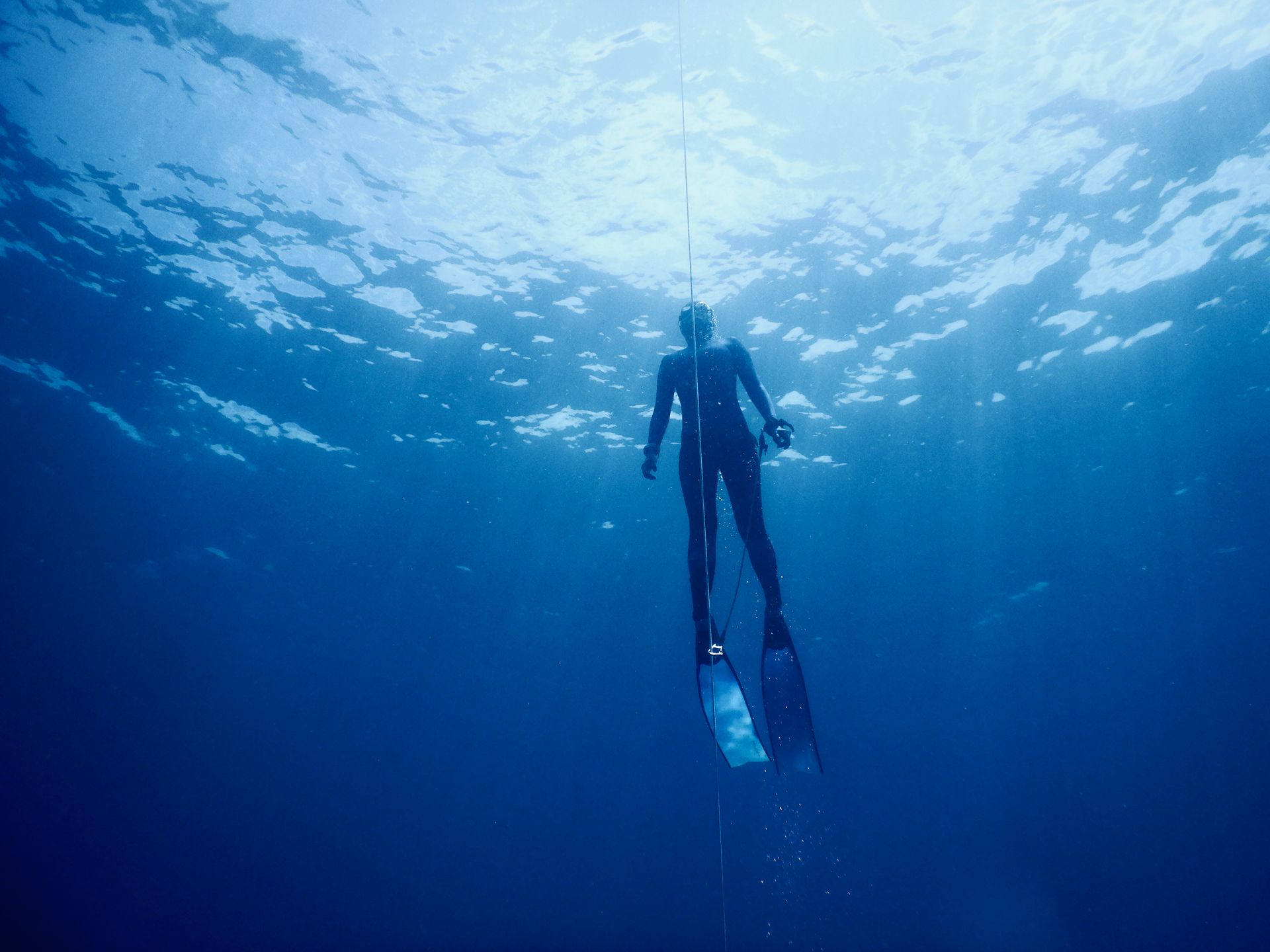
Holding your breath does not mean your body stays still
Freediving can look very simple from the outside.
We inhale.
We stop breathing.
And we wait.
But inside the body, the opposite of stillness is happening.
Within seconds, heart rate, blood vessel tone, blood flow distribution and the way we use the available oxygen begin to change.
If we also descend, another variable appears: pressure.
The lungs compress, gases change volume and circulation begins adapting to an environment the human body does not normally experience on land.
That is why freediving is not simply about “holding your breath”.
It is a complete physiological situation.
And understanding it can change the way we train.
Oxygen starts falling and CO₂ starts rising
From the moment we stop breathing, we continue consuming oxygen.
Our cells keep producing energy.
The brain keeps working.
The muscles keep working.
And as a consequence of metabolism, we also continue producing carbon dioxide, or CO₂.
During a breath-hold, two processes therefore happen at the same time:
available oxygen progressively decreases; CO₂ progressively increases.
This matters because the urge to breathe does not depend only on how much oxygen we have left.
Rising CO₂ plays an important role in stimulating breathing.
That is why a strong urge to breathe can appear while there is still a significant amount of oxygen available.
It also helps explain why trying to eliminate too much CO₂ before a breath-hold through hyperventilation can be dangerous.
It does not create a large extra reserve of oxygen.
What it can do is delay one of the signals warning us that we need to breathe.
Contractions do not mean you have run out of oxygen
At some point during a breath-hold, involuntary contractions of the respiratory muscles often appear.
For many people, especially at the beginning, they can feel like an alarm.
The body seems to be saying:
breathe now.
But a contraction does not automatically mean that we are about to run out of oxygen.
It forms part of the respiratory system's response to increasing CO₂ and to other chemical and mechanical changes occurring during the breath-hold.
Learning freediving also means learning to recognize these sensations.
Not to ignore them.
But to understand what they mean.
At Ocean Siblings, we work on this perception progressively because there is an important difference between feeling a body signal and knowing how to interpret it.
Freediving begins to change when we stop reacting automatically to every sensation and start observing what is actually happening.
The heart also changes its rhythm
One of the best-known changes during a breath-hold is bradycardia.
Heart rate tends to decrease.
This phenomenon forms part of what is known as the diving response.
Reducing the number of heartbeats can help lower part of the heart's energy demand and contributes to managing the body's available oxygen reserves more efficiently.
The response can become especially pronounced when breath-holding is combined with facial immersion and cold water.
But it is not identical in everyone.
Its intensity varies according to individual factors, experience, environmental conditions and the specific characteristics of the breath-hold.
There is no single switch that automatically puts the heart into “freediving mode”.
It is a dynamic physiological response.
And it combines with another fundamental mechanism.
The body reduces blood flow to the periphery
During a breath-hold, peripheral vasoconstriction increases.
Blood vessels in certain peripheral tissues narrow, reducing blood flow to those regions.
This helps prioritize circulation towards organs that are especially sensitive to oxygen deprivation, such as the brain and heart.
A very simplified way of describing it would be to say that the body starts managing its resources.
But that metaphor should not be taken too literally.
The limbs do not “switch off”.
And all the oxygen is not magically redirected to the brain.
What happens is a relative redistribution of blood flow that helps preserve oxygen availability in certain regions.
This combination of bradycardia and vasoconstriction is one of the central components of the human response to breath-holding.
 During a breath-hold, heart rate and blood flow distribution change as the body manages its available oxygen reserves. · Photo: Jess Loiterton · Source: Pexels · License: Pexels License
The spleen also takes part
There is another response that is much less well known and quite surprising.
The spleen can contract during repeated breath-holds.
This organ contains a reserve of red blood cells and, when it contracts, can release some of them into the circulation.
As a result, there can be a small and temporary increase in haemoglobin concentration and haematocrit.
That means that during a series of breath-holds, the body can temporarily alter its oxygen-carrying capacity.
We are not talking about creating new red blood cells in a few minutes.
And we are not talking about permanently increasing haemoglobin.
It is an acute response.
Experimental studies have observed that spleen volume decreases during repeated apneas and then gradually returns towards baseline afterwards.
This mechanism is especially interesting because it shows how the body's response to freediving involves far more than lungs and breathing.
The brain receives special attention
The brain depends continuously on oxygen.
That is why, during a breath-hold, the body attempts to preserve cerebral oxygenation for as long as possible.
Peripheral vasoconstriction and other cardiovascular changes help maintain blood flow towards central organs.
Studies measuring muscle and brain oxygenation at the same time show that the two regions do not evolve in the same way during a prolonged breath-hold.
Oxygenation in peripheral tissues can fall considerably while the body attempts to preserve cerebral circulation more effectively.
But there is a fundamental limit.
The brain is not protected indefinitely.
If oxygen availability continues to fall, cerebral hypoxia can also develop.
And when that hypoxia becomes severe enough, loss of motor control or loss of consciousness can occur.
Physiology helps delay the problem.
It does not eliminate it.
Pressure changes everything when we start descending
Up to this point, we could have been describing a static breath-hold at the surface.
But when we descend, a completely new variable appears.
Ambient pressure increases by approximately one additional atmosphere for every ten metres of seawater.
That means gases contained inside flexible spaces in the body change volume.
The lungs begin to compress.
At ten metres, in simplified terms, lung gas volume approaches half of what it was at the surface.
At twenty metres, approximately one third.
The relationship is not linear in metres because it depends on absolute pressure.
This explains why the first few metres produce particularly large changes in gas volume.
And it also explains why equalization, relaxation and technique become increasingly important as depth increases.
Blood shifts towards the chest
During a deep dive, another important phenomenon appears: the blood shift.
As the lungs compress, more blood is present in the thoracic region and pulmonary circulation.
This shift helps occupy part of the space created by the reduction in lung gas volume.
It is an extraordinary adaptation.
For a long time, residual lung volume was considered a relatively strict limit to how deep a human could descend.
Freedivers demonstrated that the body can tolerate depths far greater than initially expected.
The blood shift is one reason why.
But again, there is an important limit:
it does not make the lungs immune to pressure.
Pulmonary squeezes and other pressure-related injuries are still possible.
The adaptation reduces certain mechanical stresses.
It does not remove the laws of physics.
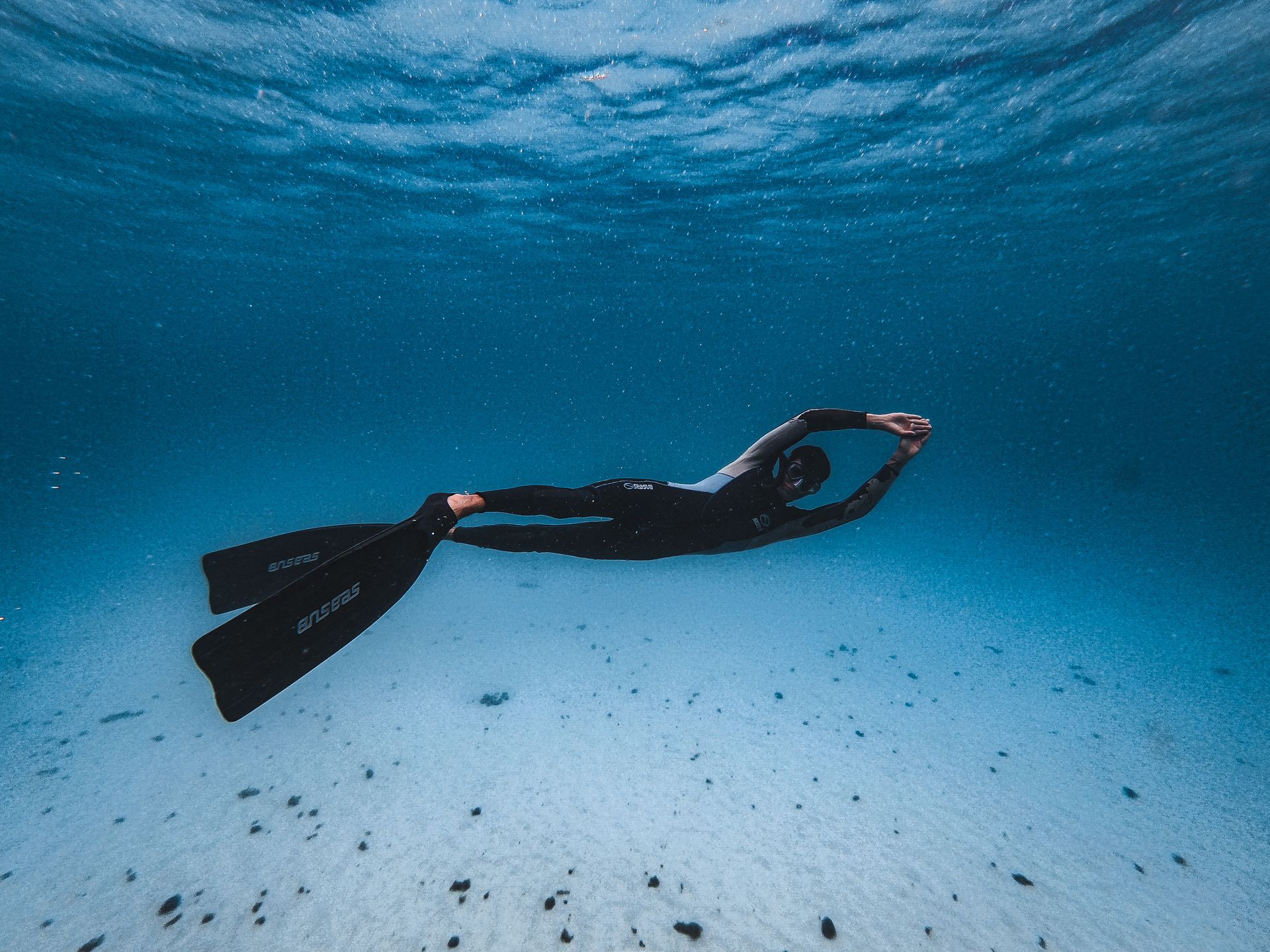 As depth increases, pressure compresses the lungs and the body redistributes blood towards the chest as part of its adaptation to immersion. · Photo: Leticia Azevedo · Source: Pexels · License: Pexels License
The ascent is not simply going back up
During descent, pressure compresses gases.
During ascent, the opposite happens.
Ambient pressure decreases and gases expand again.
The partial pressure of oxygen also changes.
This has an especially important consequence close to the surface.
A person may feel reasonably comfortable at depth and then experience a critical reduction in effective oxygen availability during the final metres of ascent.
That is why a significant proportion of hypoxic incidents in freediving occur near the surface or immediately after surfacing.
And that is why safety does not end when we can see the light above us.
The buddy must remain attentive throughout the ascent and during the first moments of recovery at the surface.
Physiology explains exactly why.
Relaxation is not only a mental issue
Relaxation is discussed a lot in freediving.
Sometimes so much that it can start to sound abstract.
But it has a very concrete physiological basis.
Muscles consume oxygen.
Movement requires energy.
Maintaining unnecessary muscular tension also has a cost.
A person who descends rigidly, makes unnecessary movements or fights against every bodily sensation is using resources that might not need to be spent.
That is why technique and relaxation are closely connected to efficiency.
It is not about trying to “stop thinking”.
It is about reducing unnecessary work.
At Ocean Siblings, we help students identify where tension appears and how their technique affects the overall experience of the dive.
Because sometimes progress does not mean having more oxygen.
It means using the oxygen we already have more efficiently.
Freediving training can also change some responses
Experience and training can modify the body's physiological response to breath-holding.
Trained freedivers often show more pronounced cardiovascular responses and greater tolerance to elevated CO₂ and reduced O₂ levels.
They may also develop greater familiarity with the internal sensations that appear during a breath-hold.
But two concepts should be kept separate.
Tolerating a sensation better does not mean eliminating the physiological risk.
An experienced freediver may feel relatively comfortable at oxygen levels that would feel extremely uncomfortable to a beginner.
That makes it even more important that progression does not depend only on subjective sensations.
Experience should be accompanied by protocols, a buddy and conservative decision-making.
Our body adapts, but it still has limits
Freediving physiology is fascinating precisely because it shows how far the human body can adapt.
The heart slows down.
Circulation changes.
The spleen releases red blood cells.
Blood is redistributed.
The lungs compress.
The brain receives priority.
And we gradually become more familiar with higher CO₂ and lower O₂ levels.
But none of these responses mean that we are immune to hypoxia, pressure or barotrauma.
Understanding the body is not a justification for pushing farther.
It helps us understand why limits exist and why they should be respected.
Learning physiology changes the way we freedive
When we understand what is happening inside the body, many sensations begin to take on a different meaning.
Contractions stop being simply an incomprehensible alarm.
The need to relax stops sounding like an abstract recommendation.
The buddy stops being an arbitrary rule.
Equalization stops being only a technique for gaining more metres.
And surface recovery begins to have a clear physiological explanation.
At Ocean Siblings, we believe teaching freediving also means explaining these things.
You do not need to become a physiologist to enjoy a dive.
But understanding the basic mechanisms helps you make better decisions, interpret sensations more accurately and progress with more judgement.
Because the better we understand what happens inside the body, the less we need to fight against it.
Editorial rigour
Sources and references
-
Source Primary source
Advances in breath-hold diving research: a state-of-the-art review
-
Source
The human diving response, its function, and its control
-
Source
Speed of spleen volume changes evoked by serial apneas
-
Source
Breath-Hold Diving
-
Source
Breath-Hold Diving – The Physiology of Diving Deep and Returning
-
Source
Hold your breath: peripheral and cerebral oxygenation during dry static apnea