


How to Equalize in Freediving: Frenzel, Common Mistakes and How to Train It
Equalization is one of the first challenges when descending in freediving. Understanding how our ears respond to pressure, equalizing early and mastering a technique like Frenzel can help us progress with greater control and without forcing.

Going deeper should not mean fighting your ears
The first few metres of a dive often teach one of the most important lessons in freediving.
We can be relaxed. We can have plenty of air. We can feel completely comfortable underwater.
And yet, there comes a point when pressure begins to build in the ears.
It is not a matter of holding your breath longer.
It is physics.
As we descend, ambient pressure increases and the air inside the middle ear is compressed. To prevent a potentially harmful pressure difference from developing, we need to introduce air into that space through the Eustachian tubes.
That is what we call equalization.
The idea sounds simple. The execution is not always so.
And one of the most common mistakes when we begin is interpreting difficulty equalizing as a sign that we need to use more force.
Usually, the opposite is true.
Good equalization depends more on timing, technique and control than on force.
Equalize before you need to
If we are already feeling strong pressure in the ear, we have waited too long.
The pressure difference increases progressively during descent, particularly in the first metres. If we allow that difference to build up, opening the Eustachian tubes may become increasingly difficult.
That is why one of the first skills we work on is equalizing early and frequently.
We do not wait for pain.
We do not even wait for obvious discomfort.
Equalization begins before the ear forces us to react.
That apparently small difference can completely change the experience of the descent.
Instead of trying to correct pressure that has already accumulated, we maintain balance progressively.
At Ocean Siblings, we place a lot of emphasis on this principle because equalization should stay ahead of pressure, not chase it.
Valsalva and Frenzel do not work in exactly the same way
Many people first discover equalization by intuitively performing a Valsalva manoeuvre.
The basic mechanism consists of closing the nose and attempting to generate pressure mainly through the respiratory muscles.
It can work well in certain situations.
But as depth increases, limitations begin to appear.
With Frenzel, however, we mainly use the tongue and structures in the throat to generate pressure while keeping the glottis closed.
That changes the mechanics considerably.
We no longer need to push from the lungs in the same way and can produce small, controlled equalizations more efficiently.
Available studies indicate that Frenzel can effectively open the Eustachian tube and that it is widely used among experienced freedivers.
That does not mean Frenzel is a magic formula.
It means that it is a technique particularly well suited to the demands of depth freediving.
And like any technical skill, it has to be learned.
Frenzel is not simply pinching your nose
This is probably one of the points where the most confusion appears.
Someone watches an instructor perform Frenzel and only sees one hand closing the nose.
But almost everything important is happening internally.
The tongue changes position.
The glottis remains closed.
The oral and pharyngeal muscles generate pressure.
And a small amount of air is directed towards the Eustachian tubes.
Coordinating these actions can feel strange at first because we normally do not consciously control many of them.
That is why learning Frenzel outside the water can be extremely useful.
We can isolate movements.
Recognize when we are using the diaphragm.
Learn how to close the glottis.
Feel what the tongue is doing.
And repeat all of this without the added pressure of descending.
At Ocean Siblings, we prefer to build that control first in simple conditions and then progressively transfer it into the water.
Because practising a complicated technique while descending is not the easiest way to learn it.
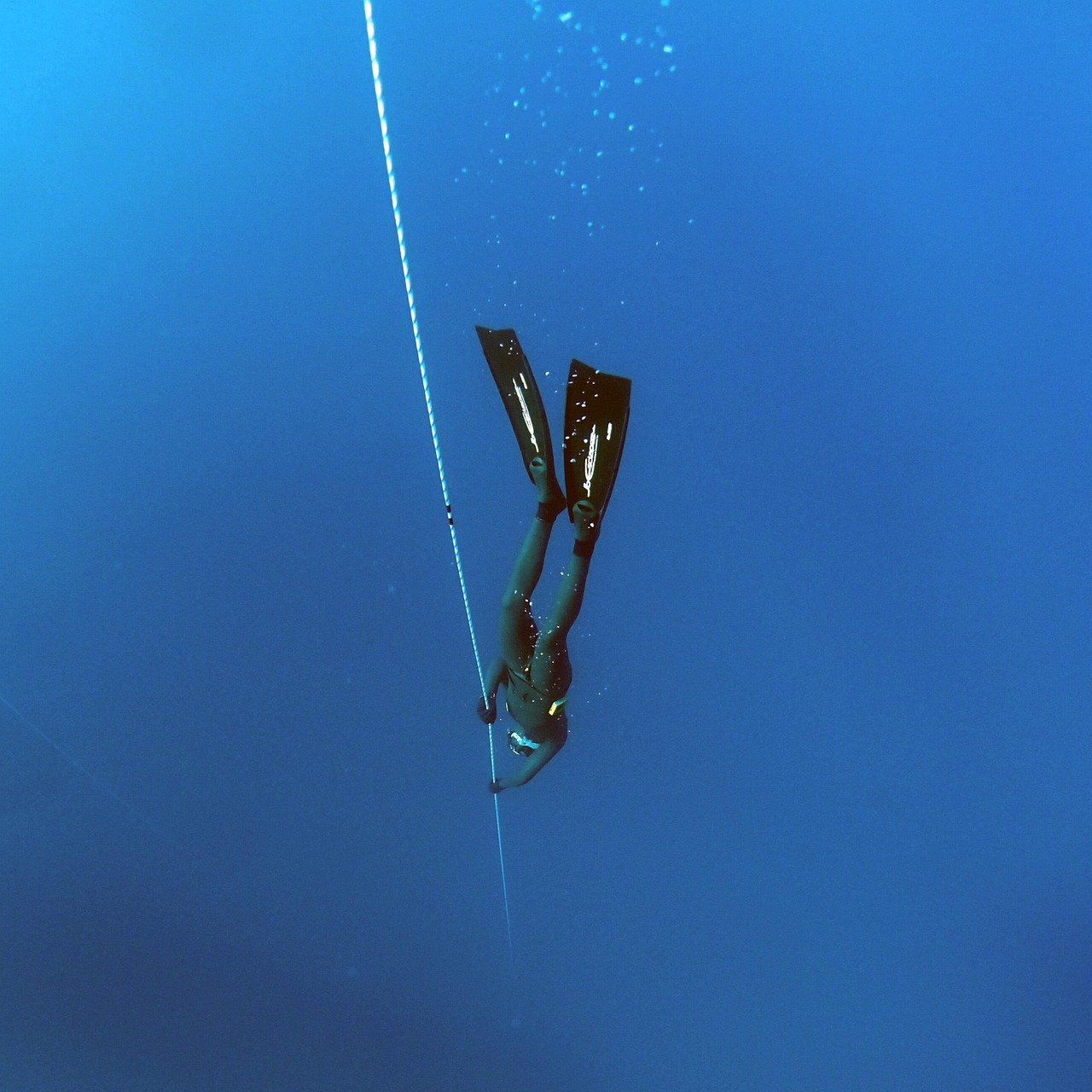 Equalization should be performed early and in a controlled way during descent, before pressure becomes painful. · Photo: Jakob Boman · Source: Pixabay · License: Pixabay Content License
The most common mistake: equalizing with more force
Imagine that we are descending.
Pressure appears.
We equalize.
It does not work.
So we try harder.
That pattern may seem logical, but it can quickly become a problem.
If a gentle equalization does not work, there are several possible reasons:
we waited too long; our head position is not helping; we are tense; the technique is not being performed correctly; we are congested; one Eustachian tube may be opening less easily than the other; or simply, equalization is not working as well that day as it normally does.
The correct response is not automatically to increase pressure.
Often, the appropriate response is to stop the descent, come up slightly and try again without forcing.
If it still does not work, that dive ends.
This can be frustrating, especially when the rest of the body feels perfectly ready to continue.
But the ear does not negotiate with our target depth.
One more metre never justifies pain
There is an important difference between pressure and pain.
Pain is not a necessary stage of learning.
It is a sign that there is a pressure difference we are not managing correctly.
Continuing to descend under those conditions can lead to middle-ear barotrauma and other pressure-related injuries.
That is why learning to abort a descent is part of learning to equalize.
It is not a technical failure.
Quite the opposite.
Recognizing that equalization is not working and stopping the descent is a good technical decision.
The metres will still be there on the next dive.
Our ears should be too.
Position can also change equalization
Equalization does not happen independently from the rest of the body.
Neck tension, head position, orientation relative to the line or the effort we are making can all affect how the technique feels and how effectively we perform it.
Many people can equalize perfectly at the surface and then discover that doing it head-down is much more difficult.
That does not necessarily mean they have forgotten the technique.
The context has changed.
That is why progression usually works better in stages:
first, we understand the movement outside the water;
then we repeat it at the surface;
next, we transfer it to shallow depths;
and only then do we begin to demand more from it.
At Ocean Siblings, we also pay attention to these details during training because many times the problem a student identifies as “my ear does not equalize” is actually a combination of timing, position, relaxation and technical execution.
Depth changes the rules
The deeper we descend, the more the air in our lungs is compressed.
That has important consequences for equalization.
At moderate depths, Frenzel can work using the available air relatively easily.
But as lung volume decreases, moving air towards the mouth and using it for equalization becomes progressively more difficult.
That is why freedivers training at greater depths eventually begin working with more advanced air-management techniques such as mouthfill.
But there is an important distinction here.
The fact that an advanced technique exists does not mean we should learn it as soon as possible.
Before thinking about mouthfill, it makes far more sense to master:
Frenzel; relaxation; position; equalization rhythm; glottis control; pressure awareness; and stable progression.
Advanced tools should solve problems we actually have.
They should not become shortcuts to reach depths we are not yet prepared for.
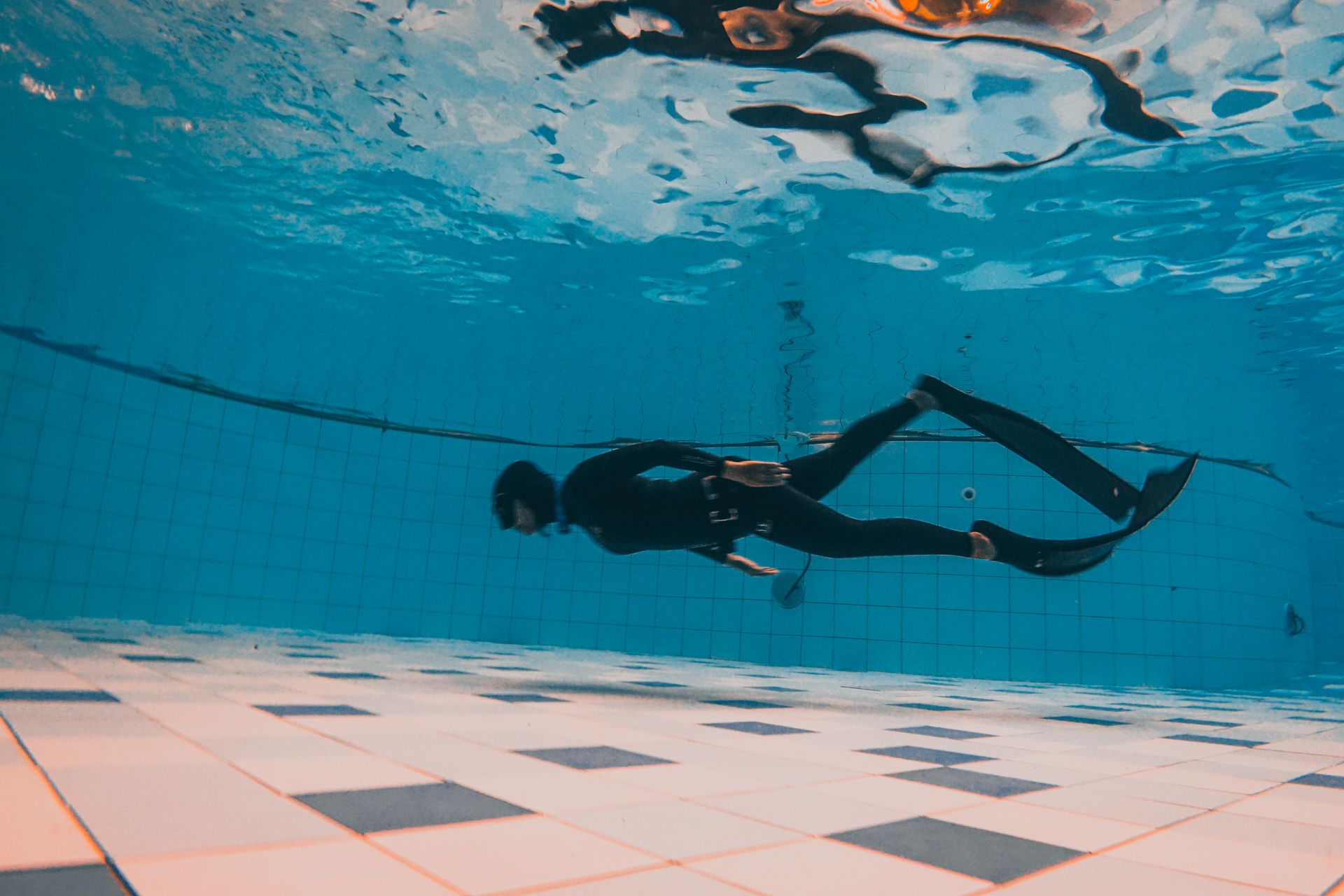 Pool training makes it possible to work on body position, control and movement efficiency in a stable environment before transferring those skills to depth. · Photo: Sonya Gabriela · Source: Pexels · License: Pexels License
Not every equalization problem is technical
We can train correctly and still have days when one ear simply does not want to cooperate.
Nasal congestion, inflammation, allergies or small anatomical differences can affect how easily the Eustachian tubes open.
It is also relatively common for one side to equalize more easily than the other.
Here, it is important not to turn every difficulty into a problem that must be solved by doing more repetitions.
If there is persistent pain, recurring difficulty equalizing, hearing loss, vertigo or other abnormal symptoms, the appropriate response is not to look for another manoeuvre online.
It is to stop the activity and consult a healthcare professional familiar with diving medicine when necessary.
Technique has limits. Recognizing them is also part of training safely.
Dry practice helps, but it does not replace the water
Frenzel has one important advantage: much of its coordination can be practised outside the water.
We can work on:
glottis closure; tongue position; pressure generation; independent control of the diaphragm; repeated small equalizations.
This makes it possible to accumulate many repetitions without having to descend constantly.
But being able to produce a Frenzel while sitting at home does not automatically mean we know how to use it while descending.
Underwater, new variables appear:
increasing pressure;
inverted position;
movement;
relaxation;
attention;
and the need to anticipate each equalization.
That is why dry training works best as preparation for a skill that then needs to be integrated in the water.
Learning to equalize changes the way we descend
At first, much of our attention is focused on the ears.
Have I equalized?
Do I need to do it again?
Why does this ear open and the other one does not?
Am I using Frenzel or am I still pushing with the diaphragm?
That is normal.
We are learning a new skill and it still requires conscious attention.
With practice, something interesting happens.
Equalization starts becoming part of the rhythm of the dive.
We equalize earlier.
We need less force.
We recognize sooner when something is not working.
And we can devote more attention to relaxation, body position and everything else happening during the descent.
That is when technique really starts doing its job.
Not allowing us to go deeper at any cost.
But making the descent progressively require less struggle.
In freediving, depth comes after technique
It is easy to measure a session by the number at the end of the line.
Ten metres.
Fifteen.
Twenty.
But a dive does not improve only because that number increases.
It may improve because we equalized earlier.
Because we stopped using unnecessary force.
Because we recognized tension.
Because we aborted a descent at the right moment.
Because a technique that required all of our attention a few weeks ago is beginning to feel natural.
At Ocean Siblings, that is how we understand equalization.
Not as an obstacle that has to be overcome in order to reach depth, but as a skill that should be controlled before we ask more from the body.
The metres will come later.
And when they do, we want the technique to already be ready to accompany us.
Editorial rigour
Sources and references
-
Source Primary source
Prospective study on the Eustachian tube function during Frenzel maneuver in a hypobaric/hyperbaric pressure chamber
-
Source
Effects of freediving on middle ear and eustachian tube function
-
Source
Chapter 1: Key Information
-
Source
Proposal of a new scoring system for equalization problems during freediving
-
Source
Going to Extremes of Lung Physiology–Deep Breath-Hold Diving
-
Source
Occurrence and resolution of freediving-induced pulmonary syndrome in breath-hold divers: an online survey of lung squeeze incidents