


Freediving Safety: How to Progress Without Skipping Steps
Freediving progress is not only about holding your breath longer or reaching greater depths. Safety is built before every dive: through technique, planning, a trained buddy, and the ability to recognize when it is better not to descend.
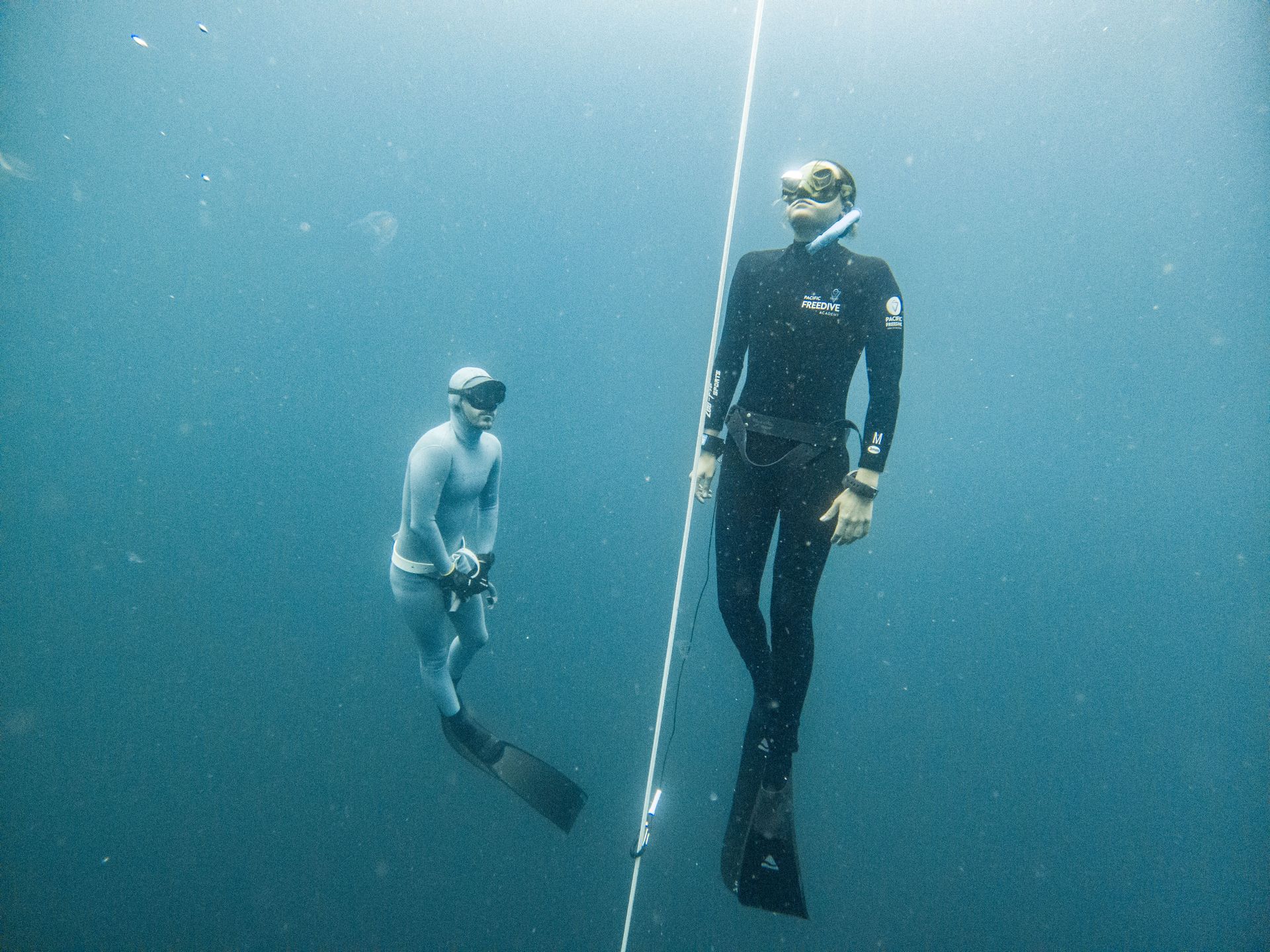
Freediving looks simple precisely because it requires so little
A mask. A pair of fins. One breath. And the sea.
From the outside, freediving can look extraordinarily simple. There is no tank, regulator or large amount of equipment between us and the water. Perhaps that is why it is also easy to underestimate everything that happens before, during and after a dive.
Because holding your breath is not the same as knowing how to freedive.
A safe dive begins long before leaving the surface. It starts with observing the conditions, checking how we feel that day, preparing the equipment, agreeing on the exercise with our buddy and knowing exactly who is diving and who is watching.
Depth is the visible part. Preparation almost never is.
And yet, that is precisely where good practice begins.
Holding your breath longer does not mean diving better
When someone starts freediving, it is easy to use two numbers to measure progress: how long they can hold their breath and how deep they can go.
They are useful figures, but incomplete ones.
Two people can reach exactly the same depth while making very different levels of effort. One may arrive tense, consume a lot of energy and struggle to equalize. The other may descend relaxed, with efficient technique and much more control throughout the dive.
The final result may be the same. The quality of the dive is not.
Learning to relax, entering the water correctly, maintaining a streamlined position, using the fins efficiently and equalizing without forcing reduces unnecessary work.
That is why, at Ocean Siblings, we do not see depth as the only measure of progress. Before adding metres, we want technique, equalization, relaxation and safety procedures to be sufficiently established.
Because the goal is not simply to go farther.
It is to get there better.
Never alone: what having a buddy really means
One of the fundamental rules of freediving is also one of the easiest to misunderstand:
We never freedive alone.
But having another person in the water does not necessarily mean that there is an adequate safety system.
The buddy needs to know what exercise we are doing, roughly how long it may last, where they should position themselves and, above all, what to observe and how to act if something goes wrong.
In a proper safety dynamic, while one person performs the dive, the other is dedicated to their safety.
This is the principle commonly known as one up, one down: one person dives while the other supervises.
That requires attention.
Not doing another dive. Not looking somewhere else. Not assuming that because everything went well ten times, it will automatically go well the eleventh.
It also requires training. A safety buddy should be able to recognize abnormal behaviour and know the basic assistance and rescue procedures.
At Ocean Siblings, we work on this relationship from the beginning because we believe that knowing how to perform a dive is only one part of freediving education.
You also need to learn how to be the buddy another freediver needs.
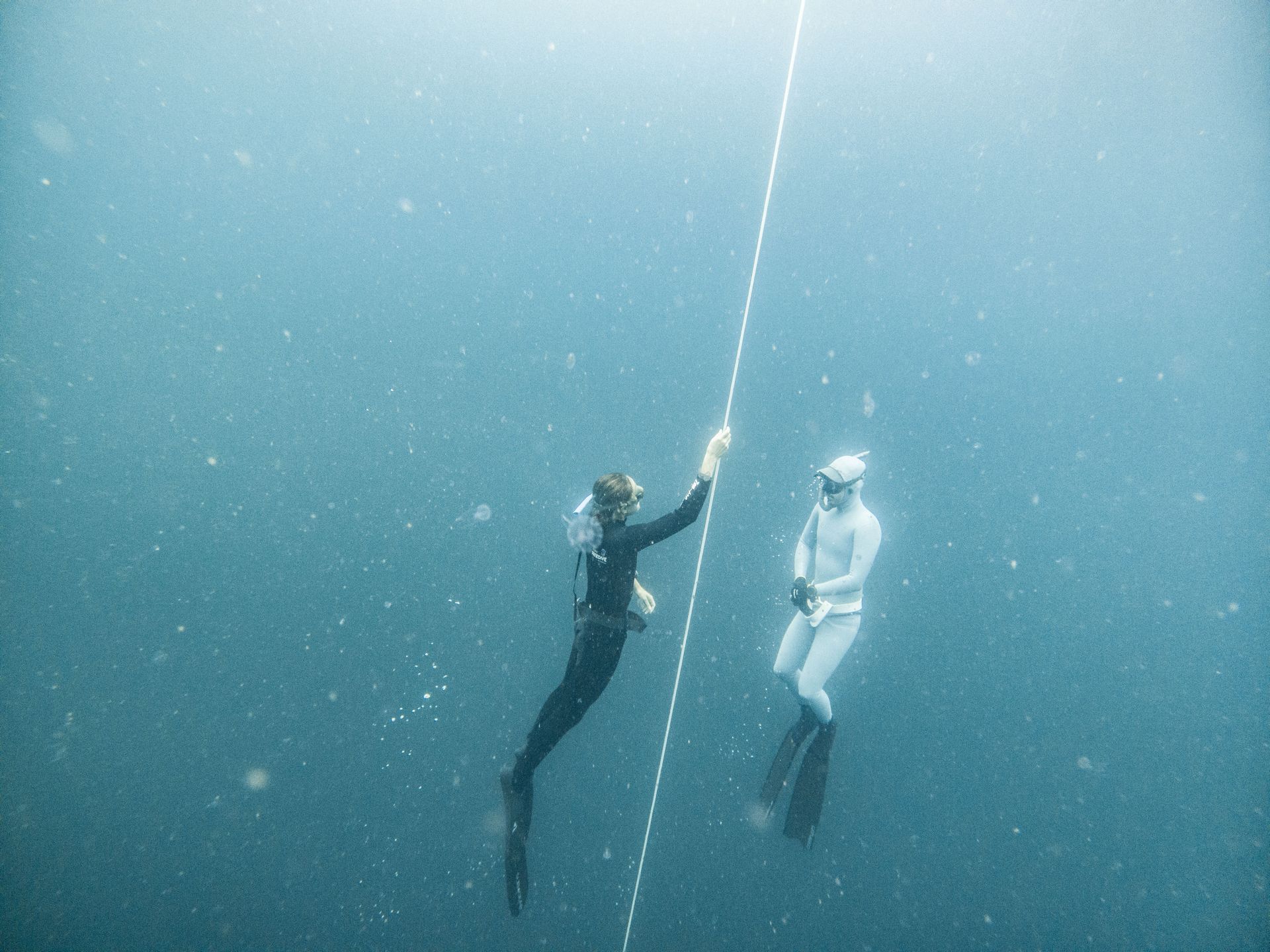 Two freedivers train beside a depth line, reinforcing the principle of supervision and buddy safety in freediving. · Photo: Michele Correa · Source: Pexels · License: Pexels License
The dive does not end when we reach the surface
Reaching the surface feels like the natural end of a freedive.
Physiologically, it should not be treated that way.
During a depth dive, pressure changes constantly. During the ascent, that pressure decreases and the availability of oxygen to the body also changes. That is why the final metres and the moments immediately after surfacing require particular attention.
Loss of motor control or blackout can occur close to the surface or even after reaching it.
That does not mean we should perform every dive expecting something to go wrong.
It means the opposite: procedures exist so that we do not have to improvise if it does.
The buddy remains attentive throughout the ascent and during the initial recovery. The freediver returns to normal breathing, and it is confirmed that they are fully conscious and coordinated.
Only then is that dive truly over.
It is an apparently small detail that shows something much more important: in freediving, safety is not a single action.
It is a sequence.
Technique also means safety
Technique is sometimes discussed as if it only existed to improve performance.
A good kick lets us travel farther. A good body position reduces drag. Efficient equalization makes the descent more comfortable.
All of that is true.
But there is another equally important consequence: using less effort to perform the same dive.
Every unnecessary movement costs energy. Every excessive body correction, inefficient kick or moment of tension adds work to an activity carried out with a limited oxygen reserve.
That is why technique and safety are more closely connected than they may appear.
A clean entry, streamlined position, controlled kick or equalization technique that does not require excessive effort are not merely aesthetic details.
They are part of learning how to use the body economically.
The same applies to relaxation.
It is not simply about “being calm”. Learning to identify tension and reduce unnecessary movement gradually transforms the way we experience freediving.
At Ocean Siblings, we spend time on these fundamentals precisely because better technique does not only help you progress: it allows you to do so with greater control.
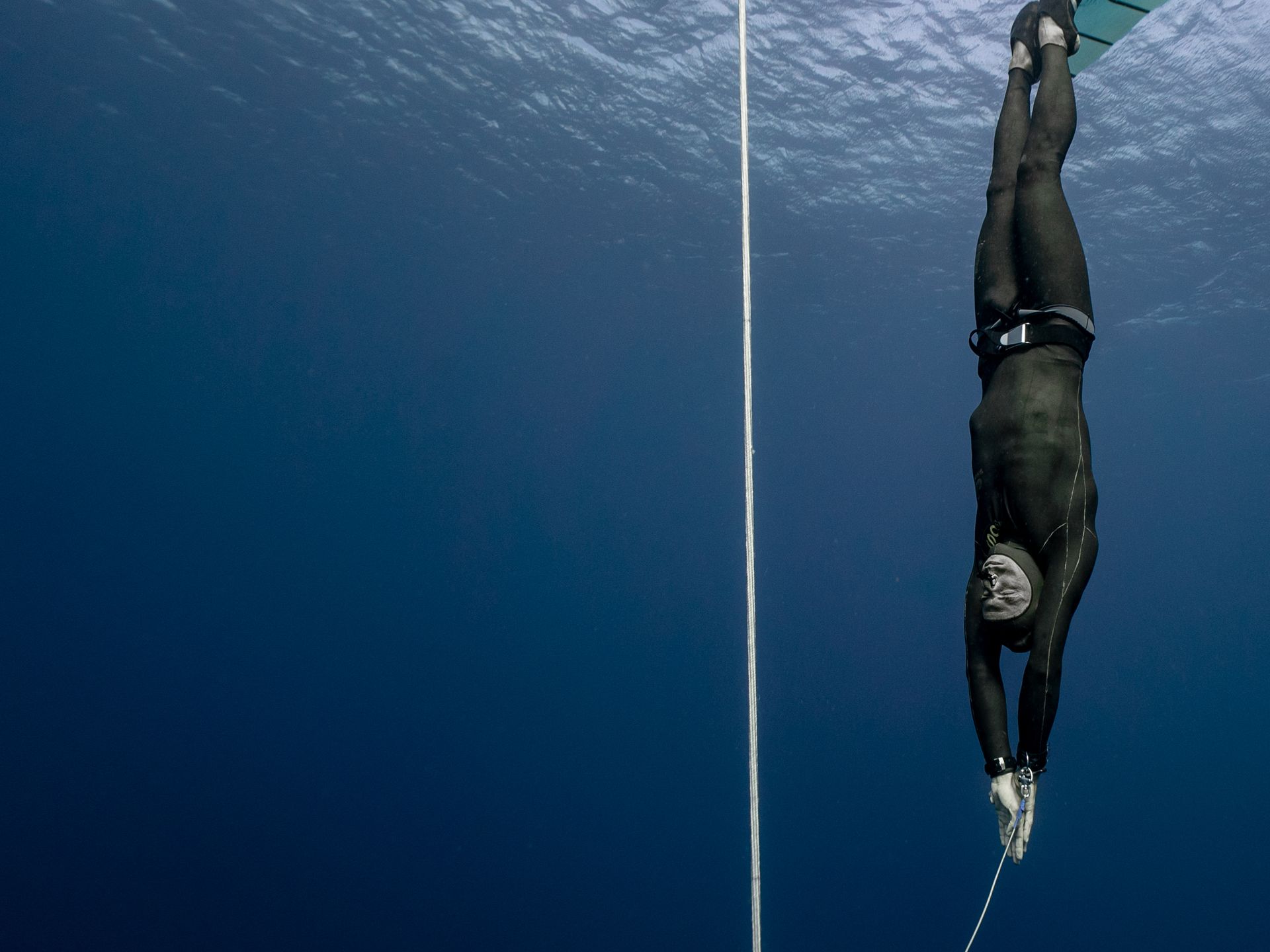 Body alignment, controlled descent and efficient movement are all part of safer freediving. · Photo: Elianne Dipp · Source: Pexels · License: Pexels License
The body does not have to perform the same way every day
There is another idea that can be difficult to accept when we begin to improve.
Our best day does not create an obligation for the next one.
Poor sleep, fatigue, stress, difficulty equalizing or different sea conditions can completely change a session.
And that is normal.
One of the easiest mistakes to make is turning our latest depth into a kind of minimum that we must repeat.
I reached this depth yesterday. Today I have to achieve at least the same.
But the sea does not know what we did yesterday.
And our body has no obligation to repeat it.
Learning freediving also means developing the ability to assess how we feel and change the objective when circumstances require it.
Sometimes progress means going one metre deeper.
At other times, it means stopping a dive early because equalization is not working as it should.
Knowing when not to descend is also a skill.
And it is probably one of the skills that takes the longest to learn.
We also train what to do when something goes wrong
A good safety culture does not mean pretending that incidents do not exist.
It means understanding them, reducing their probability and being prepared to act correctly.
Hypoxia can cause signs of loss of motor control and, under certain circumstances, loss of consciousness. A trained buddy needs to be able to recognize these signs and know how to assist the freediver.
That is why safety and rescue procedures should not be treated as an uncomfortable appendix to freediving education.
They are part of the education itself.
We practise where the buddy should position themselves, how to accompany an ascent, how to protect the airway and how to respond when someone does not react as expected.
Practising these situations in a controlled environment reduces something particularly dangerous when a real problem occurs: improvisation.
At Ocean Siblings, we want our students to enjoy the water and discover how far the human body can adapt.
But we also want them to understand what they are doing.
And to know how to respond when the person in front of them depends on them.
A culture of safety, not a list of rules
We could reduce all of this to a list:
Never train alone. Use a buddy. Do not force equalization. Check your weighting. Respect your limits.
That would be correct.
But insufficient.
A true safety culture begins when we stop following those rules simply because someone told us to, and start understanding why they exist.
When cancelling a dive no longer feels like failure.
When watching our buddy properly becomes just as important as performing our own dive.
When we choose to improve poor technique before adding depth.
When we understand that experience does not remove the need to keep applying basic safety procedures.
That is the philosophy we try to transmit at Ocean Siblings.
We are not trying to remove the challenge from freediving. Part of its appeal is precisely discovering, little by little, what we can do underwater.
What we want is for that progress to have structure.
Because the more natural a skill begins to feel, the easier it becomes to forget how much learning lies behind it.
Learning freediving means learning to make decisions underwater
The first time someone realizes they can stay underwater much longer than they expected is usually surprising.
With training, other things begin to appear: greater relaxation, better equalization, more efficient movement and, gradually, greater depth.
But metres are not the only thing that changes.
Our ability to listen to the body also changes. We become better at recognizing problems before they become larger and at deciding when to continue and when to stop.
That is where a much more interesting part of freediving begins.
It is not simply about holding your breath for longer. It is about learning to move underwater with knowledge, technique and judgement.
At Ocean Siblings, we teach freediving from that perspective: individual progression, technique, safety procedures and understanding what we are doing at every stage.
Depth will come.
We do not need to skip anything to reach it.
Editorial rigour
Sources and references
-
Source Primary source
Freediving Risk Assessments
-
Source
Freediving Safety
-
Source
Shallow-Water Blackout
-
Source
Breath-Hold Diving – The Physiology of Diving Deep and Returning
-
Source
Freediving
-
Source
The Culture of Freediving Safety